American Social Habitat Atlas
A place is more than one condition.
ASHA shows how five orders of social life overlap in a place—shaping opportunity, connection, and the capacity to thrive.
Made for eight Northwest Florida counties along the Gulf, from Pensacola to Wakulla, for the residents, congregations, nonprofits, schools, planners and officials who steward them; Washington–Baltimore and three other places are included for comparison.
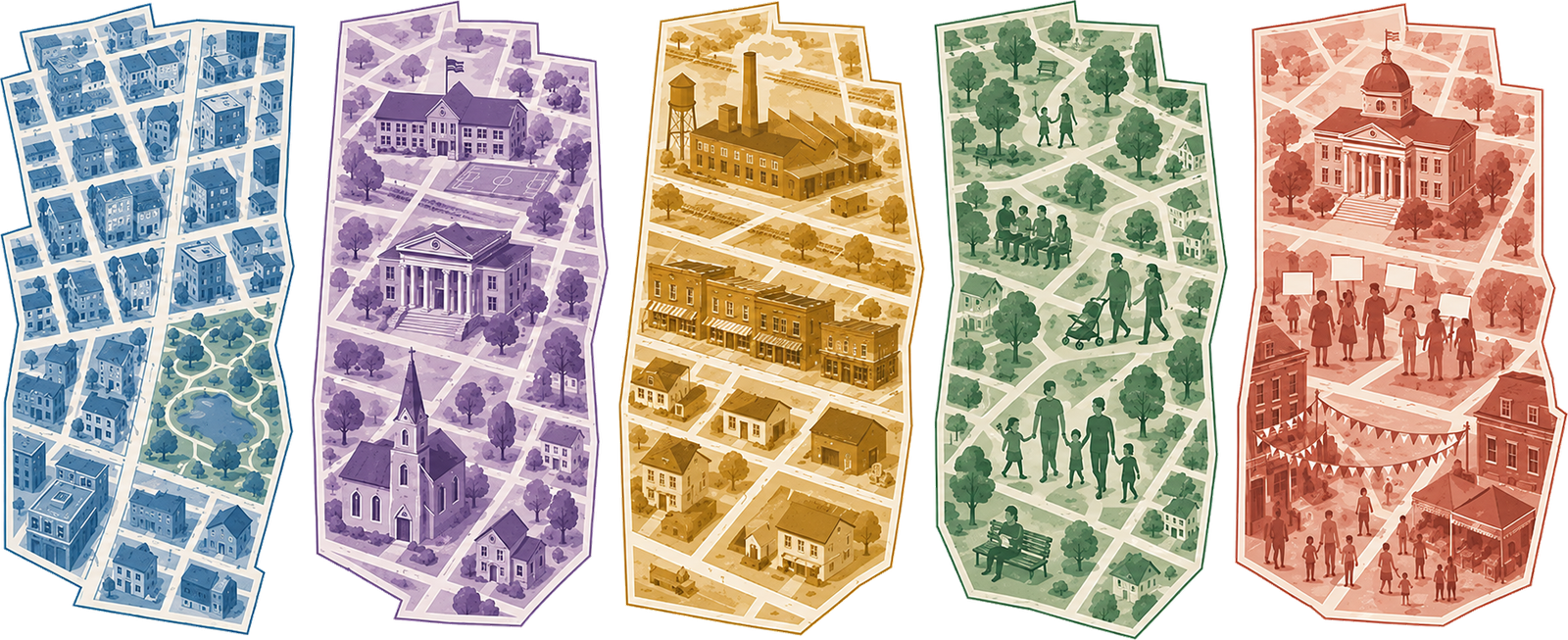
- FormalThe physical form that structures where life happens.
- InstitutionalThe rules, organizations, and resources that shape daily life.
- EconomicThe opportunities to earn, own, exchange, and build security.
- RelationalThe ties and trust that connect people to one another.
- PoliticalThe capacity to participate and shape a shared future.
Where you live shapes what your life can reach. It does not decide what your life becomes.
Good form affords the good life; it does not manufacture it. A conceptual proposition, not an empirically proven law.
The insight
Place is not neutral
Where a household lives affects what it can reach on foot or by car, how much of its income transportation consumes, what hazards it breathes and absorbs, and — perhaps most consequentially — whom its members encounter, repeatedly and by accident, in ordinary weeks. A century of urban research supports this much: settlement patterns are measurably entangled with activity, access, exposure, and contact.
The limit of form
Two dense neighborhoods can live in different worlds
Density, connectivity, and mixed use are real and measurable. But two tracts with nearly identical urban form can differ radically in their schools, their safety, their household stability, their organizations, their access to opportunity, and their capacity to act together. Much of what looks like an effect of compact form travels with income. Form matters; form alone explains less than its advocates hope.
Habitat, not hardware
Why a habitat
Built form is the habitat within which social life takes root. Households, associations, institutions, economies, and traditions interact with that habitat much as living things interact with an ecosystem: adapting to it, modifying it, inheriting it, and sometimes wearing it down or renewing it. (This is not the old “human ecology” of invasion and succession: nothing here is natural, and succession in American neighborhoods was often shaped by policy.) The habitat is co-produced: in American places the physical form is itself often the product of political acts — zoning, highway siting, disinvestment. The central claim is modest: physical design facilitates community; it does not cause it.
What places teach
Formation, not determination
The question beneath “what does this place let people do” is “what does this place teach people to become.” A front porch teaches something. A cul-de-sac teaches something. A parish, a playground, a parking lot — each teaches something, not deterministically but repetitively. Places do not determine character, but they structure repeated practices; repeated practices become habits; and habits shape persons and communities over time. This is a middle position between environmental determinism and accounts in which places merely sort people who were already going to turn out as they did.
Membership is not the same thing as connection. Connection can be partly measured (economic connectedness, from online friendships, with ZIP-code values allocated to tracts); membership — the standing to make a claim on someone — cannot. A social habitat is not merely a network of connections. It is a structure of recurring relationships, mutual dependence, inherited obligations, shared practices, and places held in common. Community begins where someone can legitimately make a claim on you — a neighbor, a child, a congregation, a town.
Neither formation nor membership is measured here. They are named so that the measures are read for what they are: the material and institutional shadow of a life that exceeds them.
Five orders
One habitat, five orders
The measures are grouped into five domains, each with its own section in every profile:
- Formal order — the physical habitat: density, mixture, connectivity, housing, movement.
- Institutional order — the institutional and associational habitat. A courthouse and a VFW post are not the same social phenomenon, and neither are a DMV office and a Black church, a mosque, a union hall, or a Little League: the first in each pair is public administration, the second is voluntary association. Each measure is tagged as one or the other, and associational life is observed far less completely.
- Economic order — the productive habitat: work, income, housing costs, enterprise, opportunity.
- Relational order — the social habitat: households, stability, connective resources. Households are treated as a primary mediating institution between person and society — the structure through which care, formation, and intergenerational continuity happen — not as a score of anyone's worth. Measured only partially, and labeled as such.
- Political order — the civic-capacity habitat: the ability to maintain, decide, and adapt together.
The five are not five of a kind. Formal order describes material conditions; economic order describes production and exchange; institutional and political order describe organized collective action; relational order describes the constitutive relationships through which people become persons-in-community in the first place. The domains mediate, moderate, and feed back on one another, and they share upstream causes. They are shown side by side, with no causal arrows drawn between them. Health and life outcomes are shown separately, because an outcome is not a condition.
Northwest Florida
Eight counties, many Floridas
The study area runs along the Panhandle from Pensacola to the Wakulla coast: an urban core with a naval history (Escambia), fast suburban growth (Santa Rosa), military-shaped communities (Okaloosa, Bay), a tourism coast against a rural interior (Walton), and small working coastal counties (Gulf, Franklin) beside Tallahassee's exurban fringe (Wakulla). Same climate, same coast — visibly different habitats.
Washington and Baltimore
Where the usual bundles come apart
The comparison region pairs two central cities and their suburbs precisely because compactness, affluence, institutional capacity, transit access, and opportunity do not move together there. Arlington and the District are dense and rich; Baltimore city is dense, after decades of population loss; Fairfax is auto-oriented and affluent; Prince George's is suburban and sharply varied tract by tract. Eight jurisdictions, eight different answers to the same geometry.
Three national cases
Against easy urban-versus-rural stories
Chittenden County, Vermont (Burlington) shows a small metro with New England town governance. Hennepin County, Minnesota (Minneapolis) shows a large Midwestern core with a strong regional-planning tradition. Orleans Parish, Louisiana (New Orleans) shows a dense, historic, culturally singular Gulf city carrying high environmental vulnerability. None of them fits a simple density-equals-flourishing narrative — which is why they are here.
How to read it
Profiles, not verdicts
Every tract and county has a profile: each measure with its value, what kind of number it is (survey estimate, modeled estimate, proxy, reallocated geography…), where it sits among comparable places, and its limitations one tap away. Compare sets two places side by side. Relationships shows how two measures move together — including among places of similar income — with sample sizes and a standing reminder that correlation is not causation. Each tract also has a one-page card with its neighborhood type, the era in which its land was first built up, and its most similar tracts. Find a place jumps to a tract from a ZIP code or an address.
What the data cannot see
Limits
- These data cannot measure virtue, belonging, or the worth of a community.
- They cannot see informal institutions: unregistered congregations, mutual aid, kin networks, volunteer groups without payroll.
- A map of places at one moment cannot prove causation.
- Nothing here substitutes for the knowledge residents already have about their own places.
- No single settlement form is prescribed, and no overall score is computed.
What cannot be measured may nevertheless be real — and may be among the most important things about a place.
Ask people why a place matters and they answer with stories: a hurricane, a base, a grandmother's house, a church or a mosque, a union hall, a football rivalry, a fishing spot, a neighborhood cut in half by an interstate, a business on the same corner for seventy years. These are not sentimental extras; they are much of how attachment and collective identity are made, and no administrative dataset observes them: memory, tradition, sacred places, informal care networks, local knowledge, custom, ritual, and attachment. The aim is not to quantify the good life but to map the material and institutional conditions within which people pursue goods that exceed measurement.
Time is the hardest of these to see. A neighborhood held by generations of interconnected families is a different habitat from an equally affluent one whose population turns over every few years, even when their census profiles match. Most measures here are snapshots. How long householders have been in place, how many arrived recently, and how old the housing is describe the people who stayed; the longevity of businesses and institutions is not observed.